
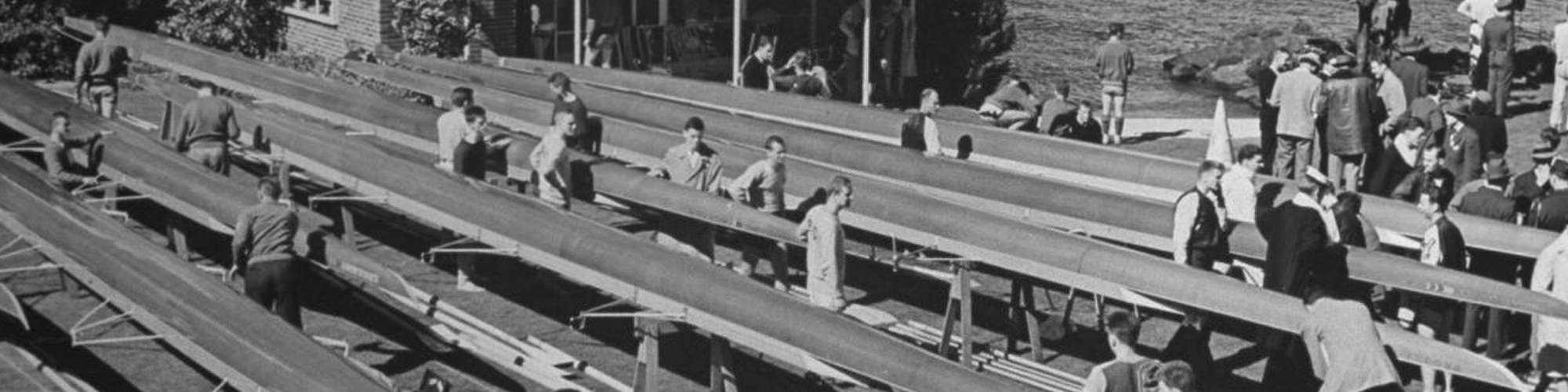
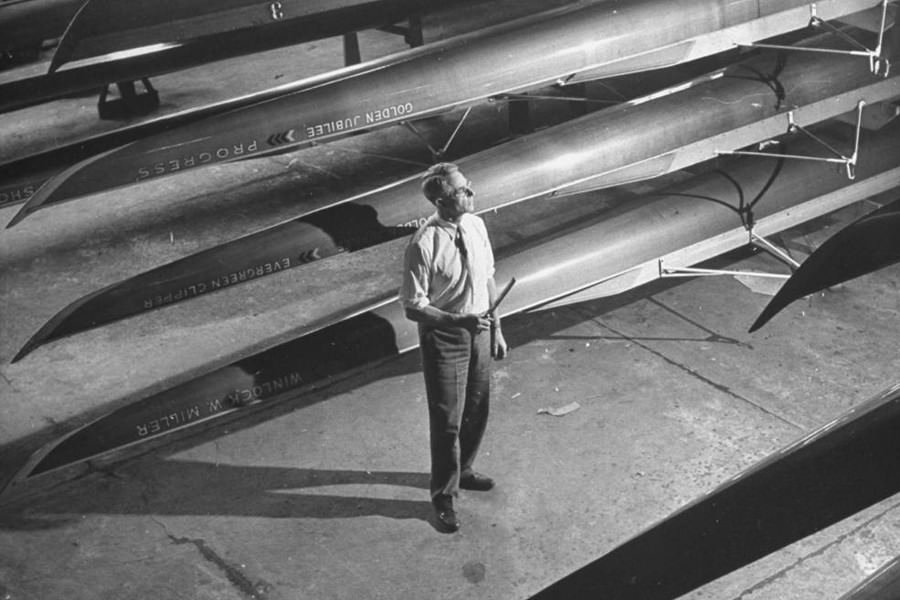
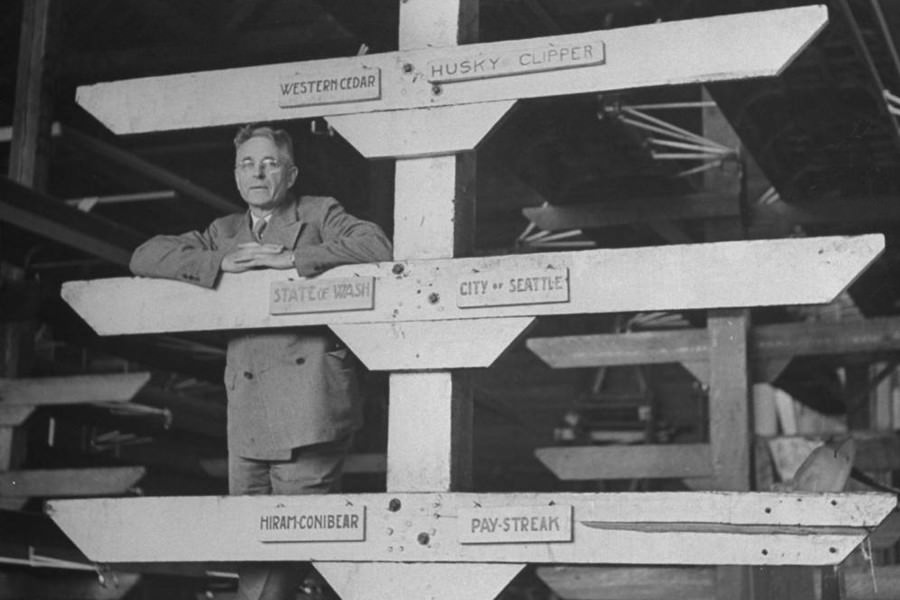
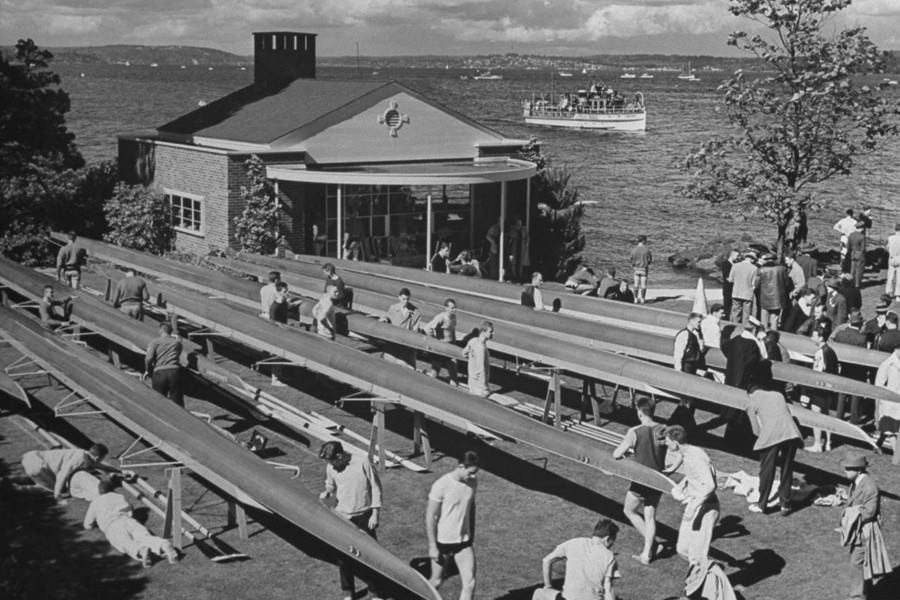
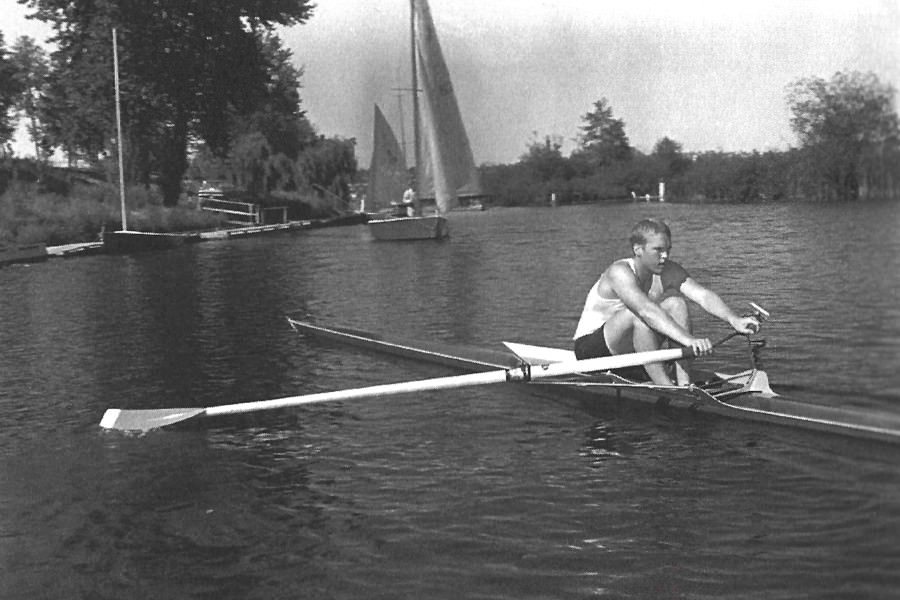
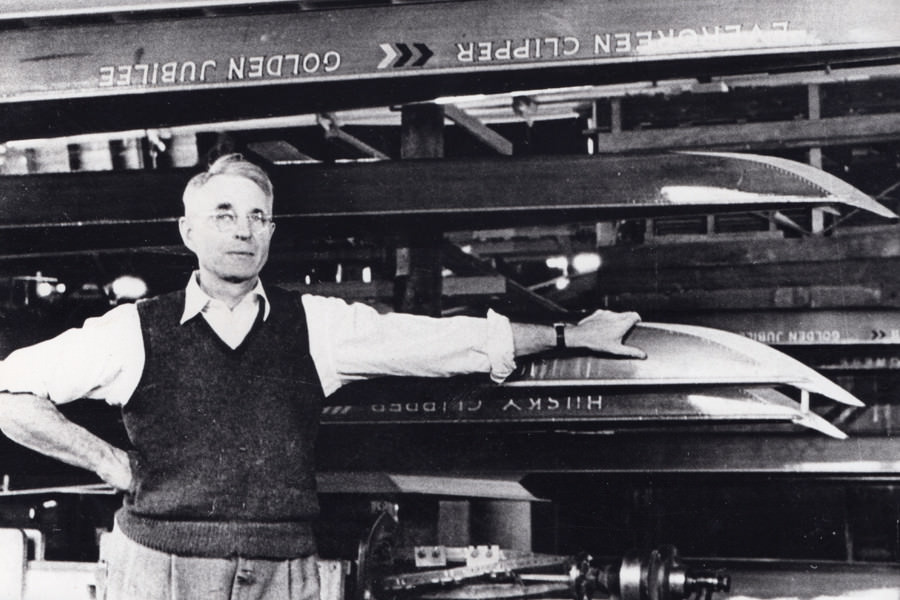
Pocock Racing Shells was founded in Seattle, Washington in 1911 and has been an integral part of nearly 100 years of American rowing. The roots of the company go back even further, starting in the 1800s with the Pocock family in their native England.
.embed-container { position: relative; padding-bottom: 56.25%; height: 0; overflow: hidden; max-width: 100%; } .embed-container iframe, .embed-container object, .embed-container embed { position: absolute; top: 0; left: 0; width: 100%; height: 100%; }
George Pocock’s father was the head boat builder for prestigious Eton College at Windsor. As a young man, George raced single shells on the famed Thames River. At one of these races he won £50, and with the money purchased passage for himself and his brother, Dick, on a cattle boat bound for Canada. In 1911, on George’s 20th birthday, they arrived in Vancouver, British Columbia, with $20 in their pockets and a dream of building fine racing boats. They rented the Vancouver Rowing Club’s boathouse for a shop and found that at low tide they rested precariously on the mud flats. Needless to say, it was not an ideal living or boat building situation. During the ensuing year, they nearly starved.

Help arrived in the midst of a winter gale when Hiram Conibear, coach of the University of Washington crew, rowed out to the boathouse and urged the brothers to come to Seattle and build boats for the university. He promised an initial order of twelve shells. Ecstatic, they headed south for Seattle. Their dream faded quickly, however, when the university only ordered one eight-man shell. Additionally, the shop space promised by Coach Conibear turned out to be a dilapidated and structurally questionable building call the Tokyo Tea Room, built as a temporary part of an exhibition.
This was their home until 1916. The initial order of one eight for the University of Washington was all they needed to gain traction. The first Pocock-built boat for Washington won the acclaimed Pacific Coast Championship. This win set the crew up for a statement-making third place finish at the 1913 national championship. Orders began to come in from regional colleges and clubs.
World War I slowed demand for racing shells, put presented another opportunity to the brothers. In 1916 a distinguished-looking man walked into their shop. After closely examining their work he left a business card. Within a few days, they were building floatplane pontoons for William E. Boeing’s new airplane company.
The Pocock’s stayed with Boeing through the war. Besides building pontoons, George traveled all over the country making inspection trips other airplane manufacturers. He reported back what he learned to the Boeing plant in Seattle. George eventually became foreman of the assembly department of Boeing.
George and Dick stayed with Boeing until 1922, when it became clear that wood was on its way out in airplane construction. Dick was anxious to leave Boeing and accepted an offer to be the boat builder for Yale University. Dick would end up spending the rest of his life building boats for Yale.
George stayed on as a foreman at Boeing, but following Dick’s departure, he too was lured back to his first love: boat building. The following year, the unknown Washington rowing team traveled east and won the 1923 national championship in a Pocock boat. After that, demand skyrocketed from coast to coast.
For the next 50 years, with care and grace, George built racing shells for nearly every racing college in the country and several abroad. His reputation spread as he maintained the highest possible quality at a price that even small colleges or high schools could afford. His boats went on to win many national and Olympic championships.
Following George’s death in 1976, the company was taken over by his son, Stan.
Stan grew up in Seattle and rowed at the University of Washington where he graduated with a degree in Engineering. Following college, he carried on the family tradition and apprenticed with his father. In the late 1960’s, management of the company became Stan’s responsibility while George devoted himself to constructing cedar single shells.
Stan was to prove himself not only as a natural in boat building but also in coaching. He was the freshman coach at the University of Washington from 1947-1955 and he coached gold medal-winning crews in the 1956 and 1960 Olympic Games.

“Rowing isn’t easy,” Stan said about the sport, “It’s so much a matter of heart. The oarsman must be sold on what he’s doing and so enthusiastic about it that the hurt doesn’t matter. Technique and conditioning are things that every oarsman has… so they become relatively unimportant. We know that men respond to rowing in a beautiful piece of equipment, and we try to give them shells that will raise their spirit a little above their competitors’.”
The post-war years were a time of incredible innovation in materials science, and it was Stan who carried the company into the modern age of composites. In fact, it was only when his father was away at the 1956 Olympics in Australia that he was first able to experiment with fiberglass. He replaced the wooden ribs in the boats with a fiberglass sandwich skin, which was an extraordinary innovation for 1956. In 1961 Stan made the first fiberglass rowing boat ever – a wherry. A few years later he developed the fiberglass training single.
Stan had ‘first-evers’ in many areas, including the development of a successful wood and glass laminated composite oar, molded seat tops, and adjustable oarlock height spacers. Building off innovations in composite engineering from aerospace industries, Stan developed the first line of all-carbon fiber monocoque racing shells in 1981. Developing the shoulderless boat was his crowning achievement.
In 2014, Stan Pocock passed away at the age of 91.
Bill Tytus took over the helm of Pocock Racing Shells in 1985.
His introduction to rowing came as a young boy riding his bicycle past the Pocock shop, which was down the road from his house. Intrigued by the sights and sounds of what he could see from the outside, the desire to pop his head inside was irresistible. After that fateful day, Bill became a frequent visitor and forged a lifelong friendship with the Pocock family.
Bill first picked up an oar in 1964 with Green Lake Crew in Seattle. His rowing career included a second place finish in the Diamond Sculls event at Henley in 1969, and he represented the USA on the National Team from 1969-1971. Today, he continues to coach sculling for the Lake Washington Rowing Club.

Bill is singularly focused on making the best boats on the market. “What many people don’t understand,” he says, “is that it is a long process. The design and construction of racing shells is continually refined throughout many years of experience, and all of these threads come together to make better products.”
“Boat building is also very sport-specific. The design and engineering that goes into making a fast sailing boat simply does not necessarily apply to racing shells’
With fifty years in the sport of rowing and over thirty years designing boats, Bill continues down the path of constant refinement, seeking the optimum balance between the various constraints and conflicting elements of boat design. This progression has been successful. The proven design of his Hypercarbon K4 and V8 designs have consistently been the top choice for America’s fastest crews. The newest iteration of this ongoing process is the revolutionary xVIII, which was released in 2016.
Today Bill remains an active advisor on all aspects of the company and continues to design the boats.